Muslim women continuously experience discrimination, biases, and negative stereotypes in every corner of the globe. The hijab has been one of the major reasons they are susceptible to these issues. While hijab is ridiculed or even banned in one part of the globe, it is strictly imposed in the other. That is, “to wear or not to wear”—both capture the extent of the problem. Even more concerning is that these harmful actions can escalate into hate crimes, which are becoming increasingly widespread both online and offline.
In response, the Institute of Islamic Studies at the University of the Philippines Diliman promoted awareness of the hijab through the UP Hijab for a Day event, which featured two activities: the Hijab Challenge and a Public Forum. The Hijab Challenge took place on February 20, 2025, with six UP Diliman units participating: the Sentro ng Wika at Filipino (SWF), the Institute of Small-Scale Industries (ISSI), the School of Library and Information Studies (SLIS), the School of Labor and Industrial Relations (SOLAIR), the College of Social Sciences and Philosophy (CSSP), and the UP Diliman Human Resource Development Office (UPD HRDO). Non-Muslim students, staff, and faculty accepted the challenge by wearing the hijab for a day while observing their experiences and the reactions of those around them.
The event culminated in a Public Forum on February 21, 2025, where participants and organizers shared their insights. The forum opened with remarks from Prof. Julkipli M. Wadi, Dean of the UP Institute of Islamic Studies, who emphasized the significance of the hijab and how the evolution of clothing norms reflects societal changes. He noted that as human beings develop a sense of guilt and shame, they begin to cover private parts. However, he observed a contrasting trend in modern fashion—while some embrace modesty, others reveal more and more skin. This shift has sparked discussions on modesty, cultural identity, and globalization’s influence. Traditional Islamic attire, such as the hijab and abaya, symbolizes adherence to religious values and cultural norms emphasizing modesty. However, modern trends and media influences have created tension between traditional dress and evolving societal expectations. For Muslim women, this shift presents challenges: it pressures some to conform to globalized beauty standards that contradict Islamic teachings, while also fostering the perception that veiling is outdated or oppressive. This dynamic shapes how Muslim women navigate their identities, balancing faith, cultural expectations, and personal expression.
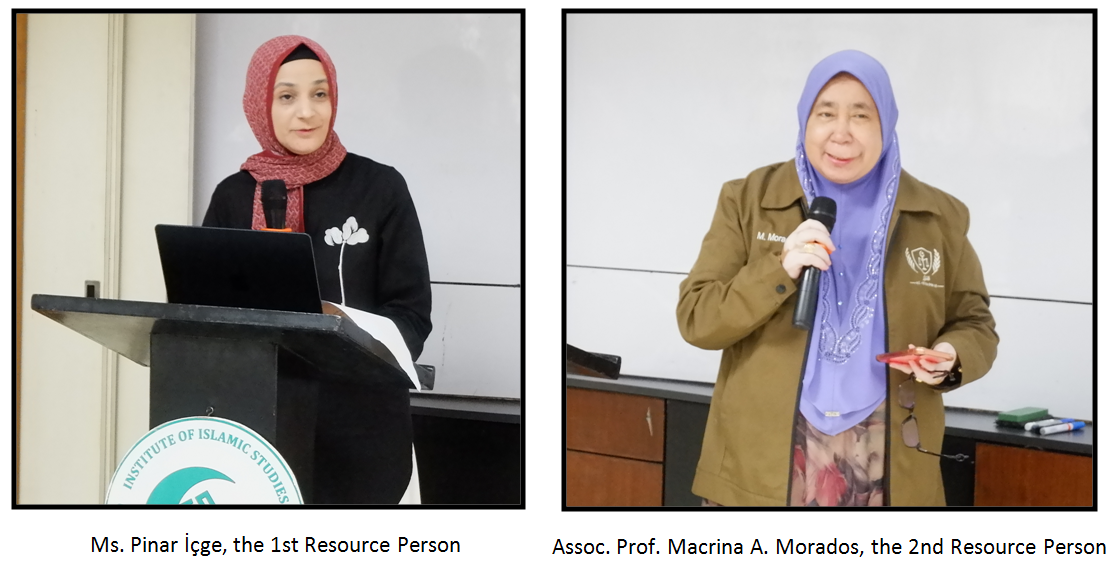
The forum also featured two lectures: “Basics of Hijab” and “Legal Guidelines on Hijab in the Philippines.” Ms. Pinar İçge of the Harmony and Wisdom Foundation, Inc. delivered the first lecture, while Assoc. Prof. Macrina A. Morados of the UP Institute of Islamic Studies presented the second. The lectures were attended by students and participants of the Hijab Challenge. Addressing the question, “Is hijab an oppression?” Ms. İçge stated, “No, ideally and inherently, the hijab is not a tool to oppress Muslim women… Rather, it is a symbol of freedom. It frees women from social pressures. However, in the contemporary world, some governments use it for oppression by banning it, while others do so by making it obligatory.” Meanwhile, Assoc. Prof. Morados emphasized the importance of understanding the legal provisions of the hijab in the Philippines, reinforcing its legitimacy as a right for Muslim Filipinos.
In the closing remarks, Ms. Lady Zaynab A. Limba shared her experiences as a hijabi and how wearing the hijab has shaped her identity. She also called for support, stressing the importance of hijabis speaking out and raising awareness about the strength they derive from wearing the hijab.
This event was organized in partnership with the Harmony and Wisdom Foundation, Inc. and the UP Muslim Students’ Association in celebration of World Hijab Day, observed annually on February 1. It is also part of the Gender and Development Program of UP IIS. Established in 2013 by U.S.-based social activist Nazma Khan, this global event promotes awareness and understanding of the hijab. In recognition of Khan’s efforts, the Philippine Senate passed a bill in 2023, authored and sponsored by Sen. Robinhood “Robin” C. Padilla, officially declaring February 1 as the National Day of Awareness on the Hijab and Other Traditional Garments and Attire.
“World Hijab Day” invites people of all backgrounds to stand in solidarity with Muslim women who choose to wear the hijab and to challenge the prejudice and misconceptions they often face because of this choice. As a “choice,” Muslim women should never carry the burden of an imposed regulation to the extent of putting at stake their precious lives.



You must be logged in to post a comment.